How to connect Cliniko to ChatGPT, Claude and any AI agent
Cliniko has an open REST API but no official MCP server (checked 26 Nov 2026). Let ChatGPT or Claude fill cancelled slots and chase invoices.
Cotlet team 12 min read
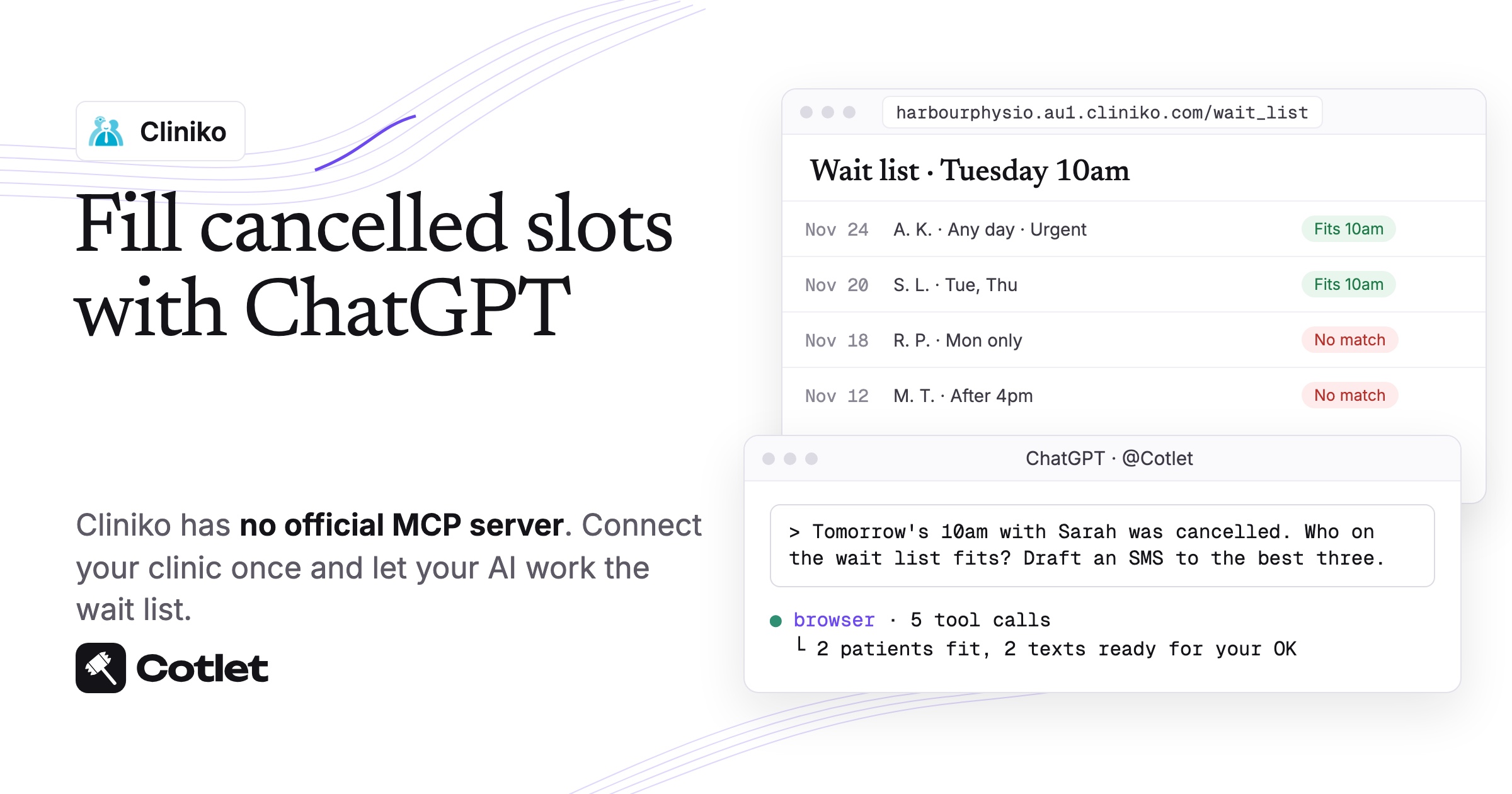
Cliniko has no official MCP server and no ChatGPT or Claude connector, as of 26 November 2026. Its REST API exists, yet only a developer can use it. The alternative is a Cloud Browser run by Cotlet: log in to Cliniko there one time, and ChatGPT, Claude or another agent handles the calendar, wait list, invoices and treatment note reports the way you would. About ten minutes, no code, no API key.
You will get the most from this if you own a physio, chiro, osteo or massage clinic, or you are the receptionist who starts Monday with a list of things nobody chased last week. Cotlet is built for whoever runs the clinic day to day in Cliniko. Patients carry on using online booking and the texts they get now.
Clinic jobs ChatGPT and Claude can do in Cliniko
Say what you need in your own words. The AI opens the Cliniko screens that hold the answer, and it can do the same on a timer.
| Part of Cliniko | What the AI handles |
|---|---|
| Wait list | Matches a freed slot to the patients who can take it, then drafts a text to each |
| Patients and recalls | Finds recent patients with no future appointment and no recall, and drafts a rebooking text |
| Outstanding invoices | Reads the report, separates patients from insurers and NDIS, and drafts a reminder for each |
| Treatment notes | Counts notes still in draft per practitioner |
| Patient forms | Lists new patients booked tomorrow who have not sent their intake form |
| Reports | Puts new patients with referral source and postcode into a sheet |
A text to a patient, an edited invoice or a booking stops and waits for you. Reading lists, counting notes and writing drafts change nothing in Cliniko.
The Cliniko MCP server page shows each screen the AI can use.
Cliniko API, AI and ChatGPT: where things stand
Where things stand on 26 November 2026:
- A public REST API. The Cliniko API covers appointments, patients, invoices, treatment notes, recalls and bookings. Any user can create a key under My info, once “Allow yourself to create and use API keys” is on. The key carries that user’s rights, and it works on a trial account too. Still, someone has to write the code.
- 103 connected apps, 37 of them AI. The connected apps directory lists AI receptionists, note scribes and business advisers, mostly from third parties. Each does a set job, such as answering calls or writing notes.
- No official MCP server. The MCP Registry has Cliniko servers published by others, such as usefulapi and tethlo, and Cliniko publishes none. They run on your API key.
- Make yes, Zapier and n8n no. There is a Cliniko app on Make. The Cliniko pages on Zapier and n8n return 404.
Got a developer? The API is the tidiest way to pull raw data. Without one, working inside your own signed-in session gets you going sooner. Does Cliniko have an API or MCP server? rates every route.
Before you start
- Your own Cliniko login. Administrators see all practitioners and businesses, and practitioners see only their own appointments and notes. The AI gets exactly what your role gets.
- The wait list in use. A freed slot only has candidates if patients were added with their preferred days and practitioners.
- A rule for “overdue”, for example 14 days for patients and 30 for third parties.
- A ChatGPT or Claude account. Free Claude is enough, because one connector is all you need.
- A Cotlet account. The trial runs a week and asks for no card (pricing).
Step 1: sign in to Cliniko in your Cloud Browser
Start from the Cloud Browser tab of your Cotlet console and load cliniko.com/login. Type your usual email and password, plus any code Cliniko requests. Cliniko forwards you to your clinic’s own address, one that ends in .cliniko.com, and once the calendar shows you can move on.
Cliniko alone receives the password, because Cotlet keeps none. What stays is an encrypted browser profile in your account. When Cliniko ends the session, your AI hands you a link to log in once more. The security page has the rest.
Step 2: point your AI at Cotlet and use Cliniko
Give your AI client Cotlet’s MCP address a single time. From then on it reaches every Cliniko screen your login can open. Choose the tile that fits your client.
Pick your AI above to see its steps.
How to connect Cliniko to ChatGPT
Do this on chatgpt.com in your browser. Cotlet then works in the ChatGPT desktop and phone apps too.
- Open Plugins in ChatGPT and click Add.
- Click Add custom MCP server. Not in the menu? Turn on Developer mode in Settings, Security and login, then come back.
- Paste the name
Cotletand the server URLhttps://cotlet.dev/mcp/v1/connect. Keep Authentication on OAuth. - Tick “I understand and want to continue” and click Create as a plugin.
- Click Connect Cotlet. A Cotlet page opens, click Allow access.
- In a new chat, type
@Cotletand pick it from the list. - Ask ChatGPT: “Are you signed in to Cotlet through MCP?” Then try a first Cliniko task: “Which Cliniko patients did not attend this month? Show practitioner and date.”
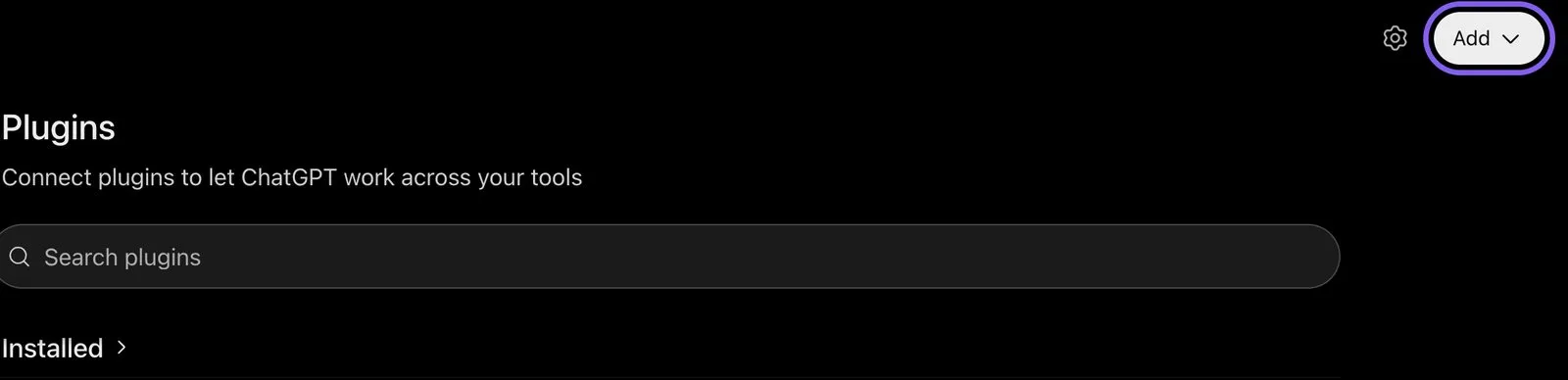
ChatGPT, Plugins page, November 2026.
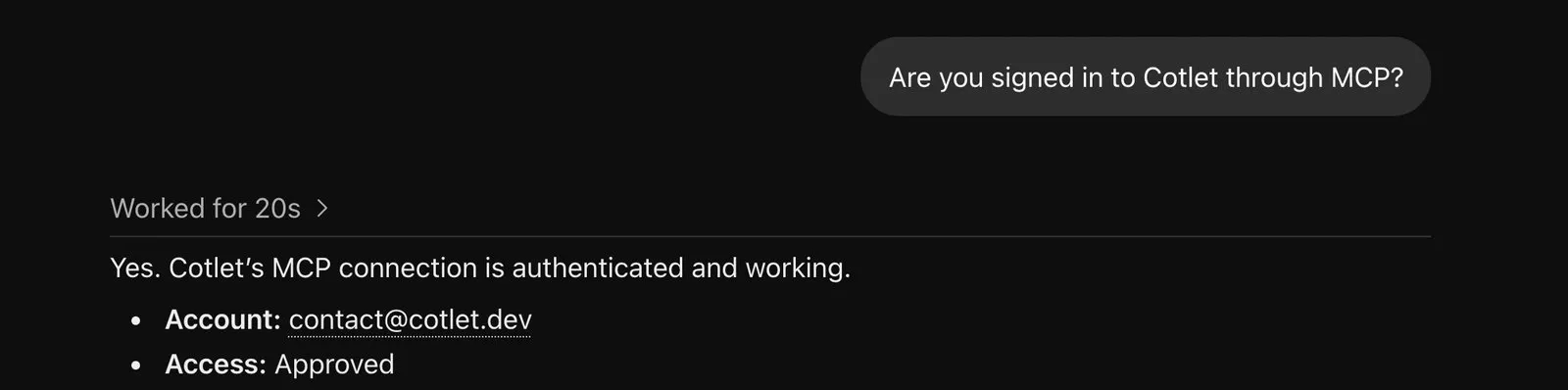
ChatGPT confirming the Cotlet connection, November 2026.
ChatGPT asks “Allow ChatGPT to use Cotlet?” before some steps. Pick Always allow, or the chat waits for your click. On a Business, Enterprise or Edu workspace, an admin has to allow custom MCP servers first.
How to connect Cliniko to Claude
- Open Connectors in Claude and click Add. In the desktop app it is under Customize, Connectors.
- Click Add custom connector.
- Paste the name
Cotletand the URLhttps://cotlet.dev/mcp/v1/connect, then click Continue. - Keep the settings and click Add.
- A Cotlet page opens. Click Allow access.
- In a chat, click the plus button, then Connectors, and turn Cotlet on.
- Ask Claude: “Are you signed in to Cotlet through MCP?”, then “Which practitioners still have draft treatment notes in Cliniko from last week?”. Claude asks before it uses a Cotlet tool the first time. Click Allow.
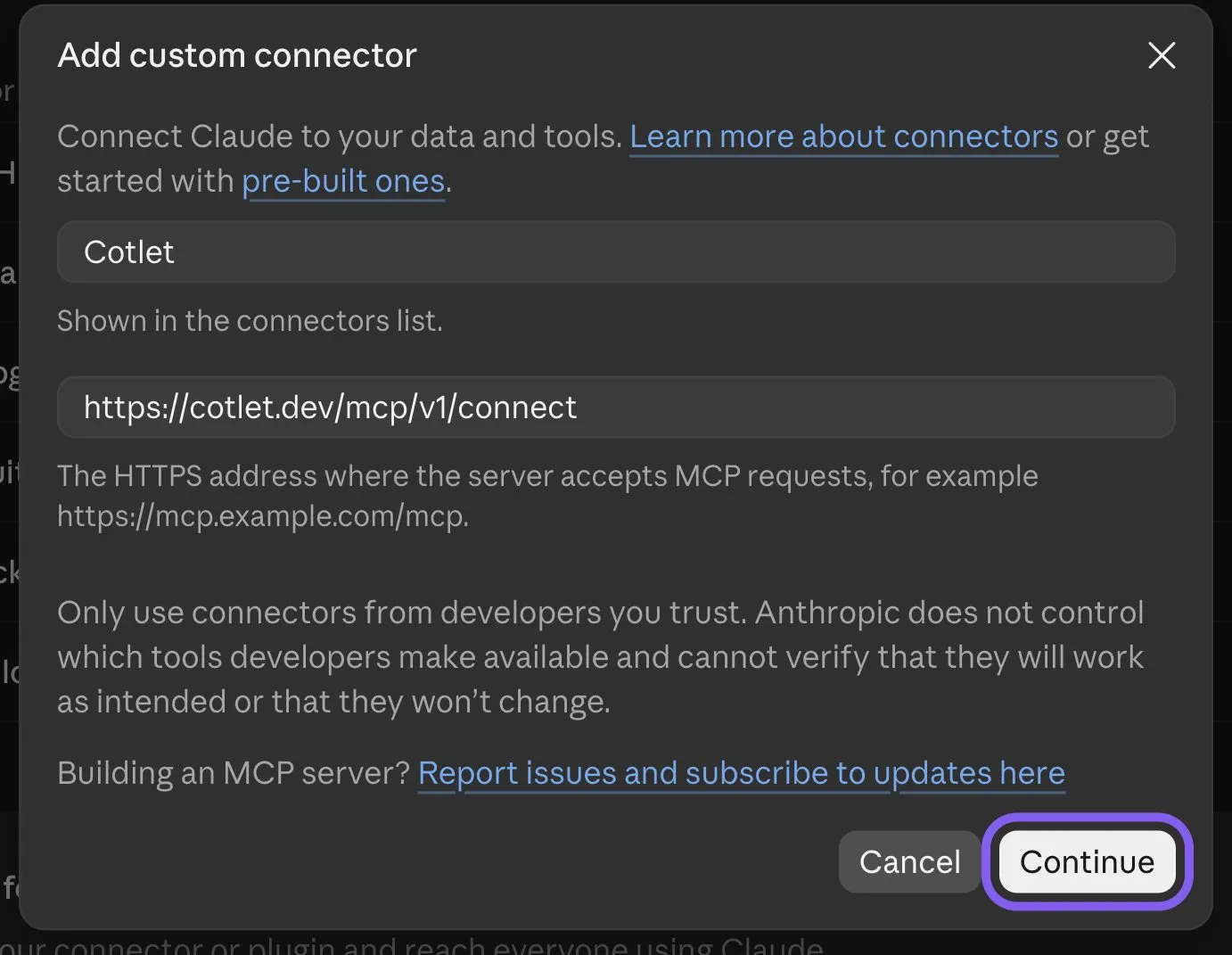
Claude, Add custom connector form, November 2026.
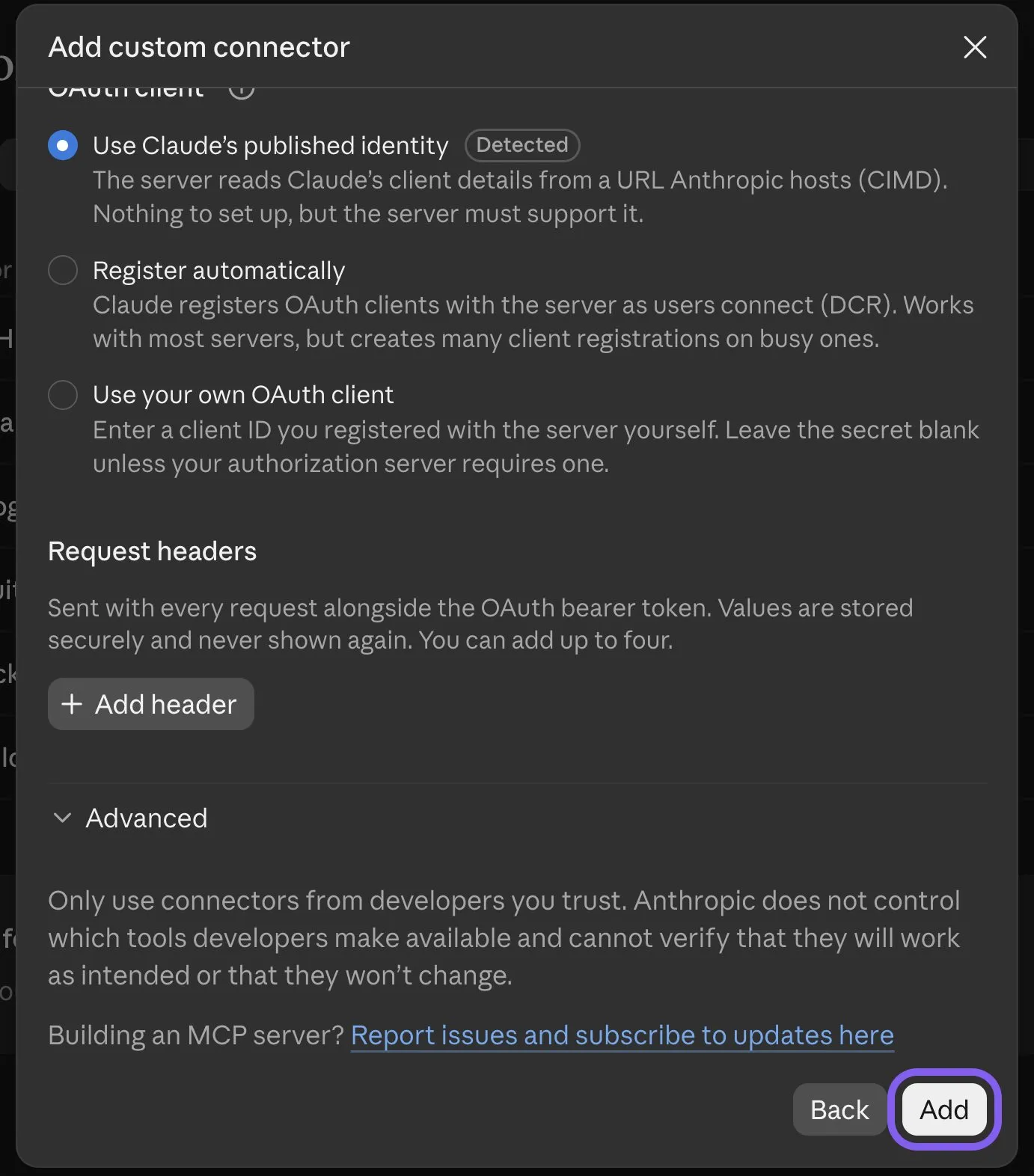
Claude, Add custom connector, last screen, November 2026.
Claude’s free plan allows one custom connector. On a Team or Enterprise plan, an owner adds Cotlet in Organization settings, Connectors, and you click Connect next to it.
How to connect Cliniko to Claude Code
Add Cotlet without a key, then sign in once in the browser:
claude mcp add --transport http cotlet https://cotlet.dev/mcp/v1/connectRun /mcp in Claude Code, pick cotlet and sign in to Cotlet. Prefer an API key, for example on a server? Create one in the Cotlet console and use:
claude mcp add --transport http cotlet https://cotlet.dev/mcp/v1 \
  --header "Authorization: Bearer $COTLET_API_KEY"
How to connect Cliniko to Codex
Create an API key in the Cotlet console, put it in the COTLET_API_KEY environment variable and add this to ~/.codex/config.toml:
[mcp_servers.cotlet]
url = "https://cotlet.dev/mcp/v1"
bearer_token_env_var = "COTLET_API_KEY"
How to connect Cliniko to Cursor
Create an API key in the Cotlet console, put it in the COTLET_API_KEY environment variable and add this to ~/.cursor/mcp.json:
{
  "mcpServers": {
    "cotlet": {
      "url": "https://cotlet.dev/mcp/v1",
      "headers": { "Authorization": "Bearer ${env:COTLET_API_KEY}" }
    }
  }
}
How to connect Cliniko to Grok
Grok takes custom MCP servers on grok.com, per xAI’s connectors documentation (checked 8 November 2026).
- Open grok.com/connectors and click New Connector.
- Pick Custom and paste the server URL
https://cotlet.dev/mcp/v1/connect. - Sign in to Cotlet when Grok asks, then click Allow access.
- Ask Grok: “Are you signed in to Cotlet through MCP?”
On Grok Business, an admin adds the connector first in the xAI console, under Grok Business, Connectors. The Grok chat inside X has no custom connector menu.
How to connect Cliniko to Hermes Agent
Add Cotlet to ~/.hermes/config.yaml in the format of the Hermes MCP config reference:
mcp_servers:
  cotlet:
    url: "https://cotlet.dev/mcp/v1"
    headers:
      Authorization: "Bearer ${COTLET_API_KEY}"
    trust: untrusted
Put COTLET_API_KEY in ~/.hermes/.env and check it with hermes mcp test cotlet. With trust: untrusted, Hermes runs reads at once and asks before every write. More on Hermes in our post on the Hermes Agent browser.
How to connect Cliniko to n8n
Use the MCP Client node, or the MCP Client Tool inside an AI Agent node:
- Server Transport: HTTP Streamable
- MCP Endpoint URL:
https://cotlet.dev/mcp/v1 - Authentication: Bearer Auth, with your Cotlet API key as the token
- Tools: let the AI Agent node use Cotlet’s browser tools; it reads Cotlet’s Cliniko guide first and works in your signed-in Cliniko account
Use it for work that should run on its own, such as a Monday 8 am list of invoices older than 14 days.
Any other MCP client
Point the client at https://cotlet.dev/mcp/v1 over Streamable HTTP, with the header Authorization: Bearer <your Cotlet API key>. A client that supports OAuth sign-in can use https://cotlet.dev/mcp/v1/connect instead and needs no key. The full reference is in the MCP docs.
Try them early on Monday, ahead of the first patient.
Fill the slot a cancellation left open
Tomorrow’s 10am with Sarah was cancelled. Who on the wait list fits that slot? Draft an SMS to the best three. Send nothing yet.
Each wait list entry records the days of the week the patient can attend, the practitioners they want, whether the need is urgent and when the entry expires. The AI reads the entries, drops those that cannot do a Tuesday morning or do not want Sarah, and ranks the rest with urgent ones first. It writes three short texts and waits. Once you approve, it sends them.
Count the treatment notes still open
Which practitioners still have draft treatment notes from last week? Give me a count per practitioner.
Cliniko’s treatment note completion report lists appointments with no final note, and it mixes missing notes with drafts. Telling the two apart takes a treatment notes data export, which only administrators can run. The AI runs the report, downloads the export, keeps the drafts and counts them by practitioner. You get four lines instead of an hour in a spreadsheet.
Chase invoices, patients and payers apart
List outstanding invoices older than 14 days. Split patients from third parties like insurers and NDIS, and draft a reminder for each.
The Outstanding invoices report can be filtered by business and practitioner, and each invoice number opens the invoice itself. The AI reads the report, sorts patients from payers, and drafts a short note in your voice for each group. A patient reminder is polite, and a payer note quotes the invoice number and date. You review the drafts, and nothing goes out before your OK.
Cotlet pricing beside your Cliniko invoice
Nothing changes on your Cliniko invoice. On the Cotlet side you pay once for a pack, with no subscription: $29 buys 5,000 credits that last 12 months. Successful calls cost 10 to 100 credits each, and failures are free. When the trial is over, keeping Cliniko connected costs 50 credits per day. The trial is 500 credits for 7 days, with no card needed (pricing).
FAQ
Can I call the Cliniko API for my clinic?
Yes. Cliniko has an official REST API, and each user creates a key under My info. It needs a developer to call it. Cotlet asks for no key, since it runs inside your signed-in Cliniko account.
Cliniko has an API. Why use Cotlet?
The API suits a developer who wants exact fields. A clinic owner wants the wait list checked and the invoices chased. With Cotlet, ChatGPT or Claude uses the screens you already know. Ask for the list and you get the list.
Can I use the Cliniko API with ChatGPT if I am not a developer?
Not directly, because ChatGPT cannot call it for you without code or an extra tool. Cotlet adds the missing piece. You sign in to Cliniko once, and ChatGPT works inside that session.
Is there an official Cliniko MCP server?
No. The MCP Registry lists Cliniko servers from third parties and none from Cliniko, and the Claude directory has no Cliniko connector. Those servers need your API key, while Cotlet works through the session you opened.
How do I connect Cliniko to Claude without installing an MCP server myself?
Add Cotlet as a custom connector in Claude, with the address from step 2, and sign in to Cliniko in your Cloud Browser. Nothing is installed on your computer.
Can I get Cliniko data into Google Sheets or Xero without Zapier?
Yes. Cliniko has no Zapier app, so the AI opens the report in your account and fills the sheet. A good first one is this month’s new patients with referral source, postcode and first practitioner. Export your data covers the file route.
Can AI read the SMS replies to my reminders?
Yes. Ask it each morning to read the replies, list who wants to cancel or move, and match them to free slots. It drafts the answers and waits for your OK.
Can AI do the front desk admin in my Cliniko account?
Yes, for the jobs that follow the screens: the wait list, rebooking lists, overdue invoices and intake form reminders. Anything that reaches a patient waits for your OK.
Is Cotlet part of Cliniko?
No. Cotlet is a separate company, and whatever it does happens as the user who signed in.
Start the week with the list done
Every hour a cancelled 10am stays empty is money gone. Open a free trial, log in to Cliniko through the Cloud Browser and ask ChatGPT which wait list patient can take the slot. Related clinic tools are in the catalog.