How to connect TurboTenant to ChatGPT, Claude and any AI agent
TurboTenant's MCP server searches rentals for renters, not your landlord account (checked 26 Nov 2026). Let Claude chase rent and sort repair requests.
Cotlet team 11 min read
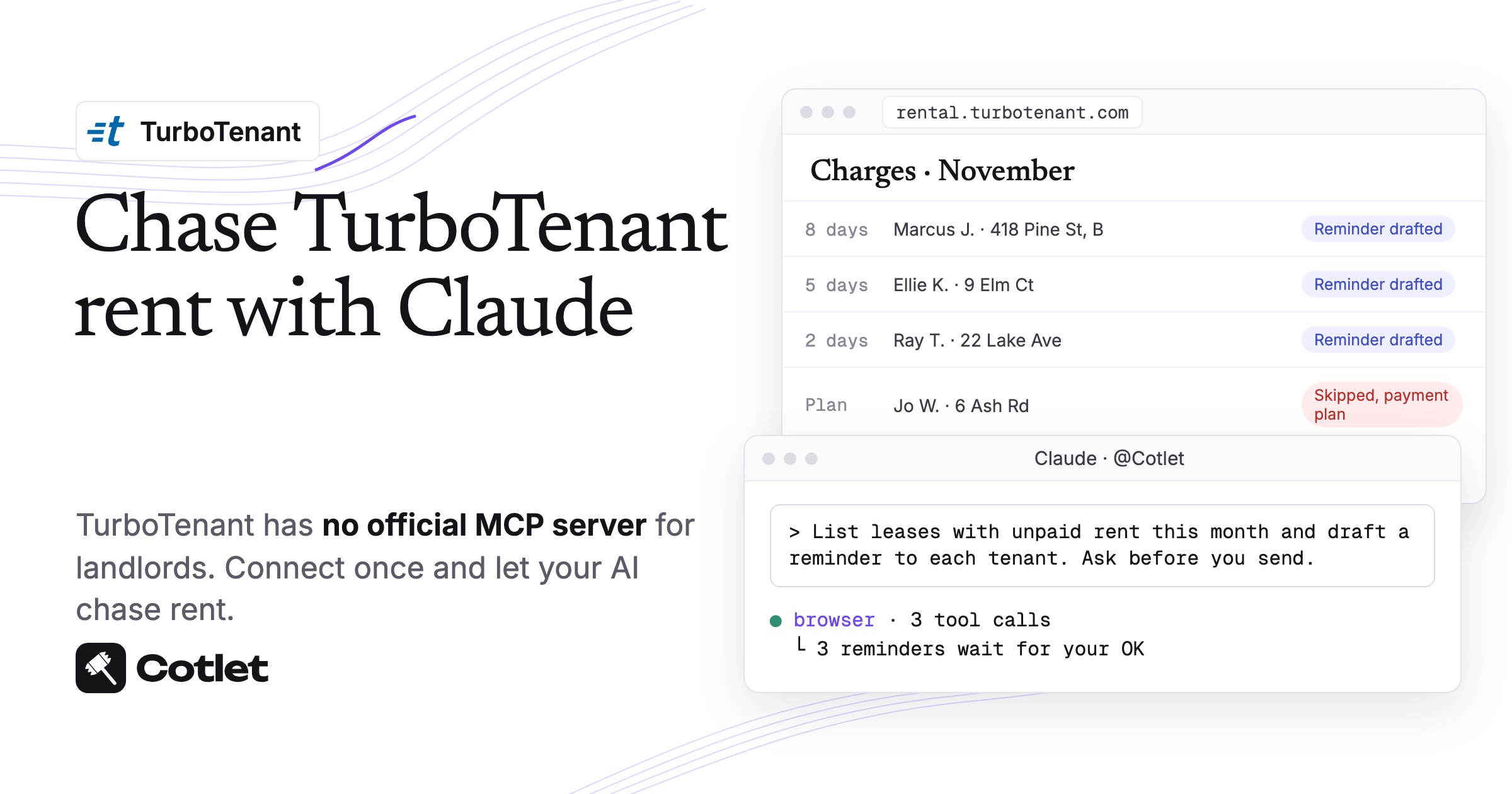
TurboTenant has no official MCP server for your landlord account and no public API, as checked on 26 November 2026. It does run an MCP server for ChatGPT and Claude Desktop, but that one only searches its rental listings for people looking for a home. To give ChatGPT, Claude or another AI agent your rent charges, maintenance requests, leads and leases, connect TurboTenant through Cotlet. You sign in once inside your own Cloud Browser, and the AI works in your landlord dashboard the way you do. Setup takes about ten minutes, without code.
TurboTenant is where a lot of independent landlords run a handful of doors: listing a unit, screening applicants, signing a lease, collecting rent online and handling repair requests. The people searching for an AI link are usually those landlords, often with a day job, checking payments on the 3rd and repair photos at night. Cotlet works for the landlord. Renters keep using TurboTenant’s own tools to find and apply for a place, and the TurboTenant listing search in ChatGPT is part of that renter side.
What ChatGPT and Claude can do in TurboTenant once connected
Landlords usually start with one of these areas of the TurboTenant dashboard:
| Area of TurboTenant | What the AI handles |
|---|---|
| Payments and charges | Lists unpaid rent and late fees by lease, drafts a reminder per tenant |
| Maintenance | Sorts open requests by property and urgency, drafts a reply to the tenant |
| Leads | Reads new leads with pre-screener answers, drafts a reply with showing times |
| Applications | Puts this week’s applicants side by side and lists what is missing |
| Leases | Finds leases ending in 60 days and drafts a renewal offer |
| Reports | Exports the rent roll and the tax packet and totals them per property |
A message to a tenant or applicant, a lease change and a new status on a request all wait for your OK. Reading and exporting change nothing, and the AI never moves money.
The screens and the approval rules are on the TurboTenant MCP server page. For rent data in a sheet or n8n, see TurboTenant API with Cotlet, and the sourced check of what TurboTenant offers is on Does TurboTenant have an API or MCP server?.
Does TurboTenant have AI, an API or an official ChatGPT app?
TurboTenant points its AI at renters, not landlords. As of 26 November 2026:
- An MCP server, for renters. At gpt-app.turbotenant.com TurboTenant offers “TurboTenant for ChatGPT & Claude Desktop”. Its tools search active rental listings by location, refine the results and show listing details. Nothing in it reads your charges, leases or repair requests.
- No public API and no developer docs. turbotenant.com has no API reference or keys for landlords.
- No Zapier, Make or n8n app. TurboTenant has no listing in any of the three automation catalogs.
- CSV exports by hand. Rent payments export from Payments, Charges (help article), and the rent roll from Insights, Reports (help article). A tax packet export is there for your accountant.
So for a landlord who wants the AI to work the account, a hosted MCP server inside your own signed-in session is the route today. If TurboTenant opens an API for landlords later, use it for code.
Before you start
- Your landlord credentials for rental.turbotenant.com. A renter login opens a different side of the app.
- Your rentals entered in TurboTenant, with their leases.
- A sentence on how you handle late rent: the grace days and the tone of a first nudge.
- ChatGPT, or Claude on any plan, because Cotlet uses only one connector slot.
- A Cotlet account, which runs free for its first seven days (pricing).
Step 1: sign in to TurboTenant in your Cloud Browser
Start the Web browser from your Cotlet console (cotlet.dev/app/browser/web), then visit rental.turbotenant.com. Pick the landlord option and log in. Should TurboTenant ask for a confirmation code, enter it on its page.
Only TurboTenant receives what you type into its login form. Cotlet keeps no password, and the session itself is stored in an encrypted profile. If you want the agent out, one toggle in the console does it. A logged-out session simply pauses the agent until you follow the link it sends. More: security.
Step 2: connect TurboTenant to ChatGPT, Claude or another AI agent
Tap the assistant you use for your rentals and follow its short list of steps.
Pick your AI above to see its steps.
How to connect TurboTenant to ChatGPT
Do this on chatgpt.com in your browser. Cotlet then works in the ChatGPT desktop and phone apps too.
- Open Plugins in ChatGPT and click Add.
- Click Add custom MCP server. Not in the menu? Turn on Developer mode in Settings, Security and login, then come back.
- Paste the name
Cotletand the server URLhttps://cotlet.dev/mcp/v1/connect. Keep Authentication on OAuth. - Tick “I understand and want to continue” and click Create as a plugin.
- Click Connect Cotlet. A Cotlet page opens, click Allow access.
- In a new chat, type
@Cotletand pick it from the list. - Ask ChatGPT: “Are you signed in to Cotlet through MCP?” Then try a first TurboTenant task: “Which TurboTenant leases still have unpaid rent this month?”
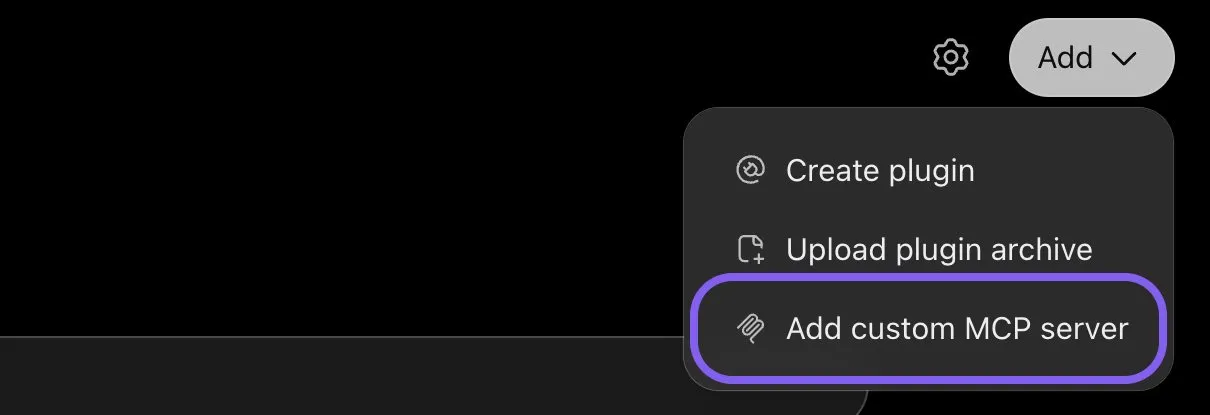
ChatGPT, Add menu on the Plugins page, November 2026.
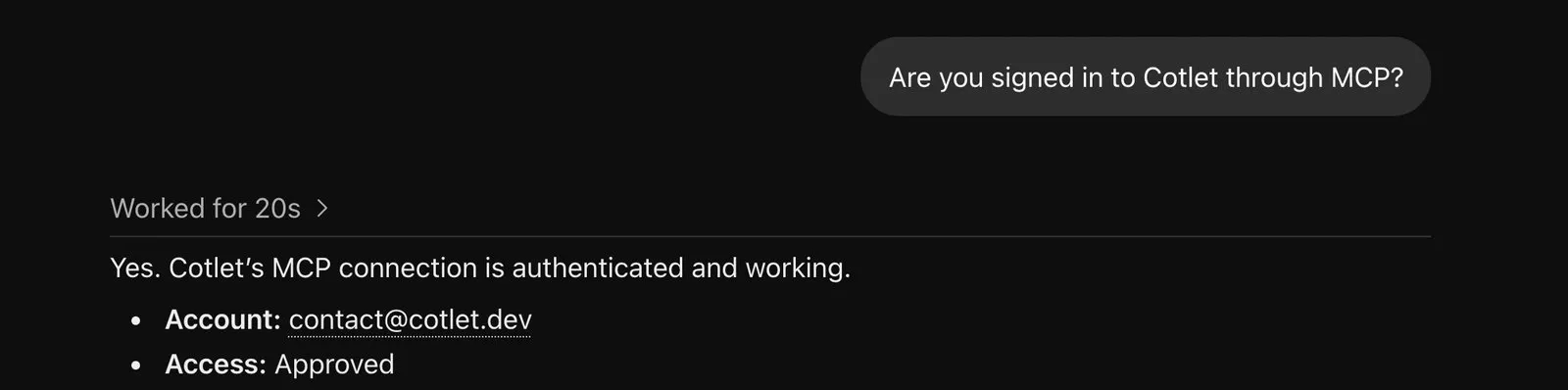
ChatGPT confirming the Cotlet connection, November 2026.
ChatGPT asks “Allow ChatGPT to use Cotlet?” before some steps. Pick Always allow, or the chat waits for your click. On a Business, Enterprise or Edu workspace, an admin has to allow custom MCP servers first.
How to connect TurboTenant to Claude
- Open Connectors in Claude and click Add. In the desktop app it is under Customize, Connectors.
- Click Add custom connector.
- Paste the name
Cotletand the URLhttps://cotlet.dev/mcp/v1/connect, then click Continue. - Keep the settings and click Add.
- A Cotlet page opens. Click Allow access.
- In a chat, click the plus button, then Connectors, and turn Cotlet on.
- Ask Claude: “Are you signed in to Cotlet through MCP?”, then “List my open TurboTenant maintenance requests by urgency.”. Claude asks before it uses a Cotlet tool the first time. Click Allow.
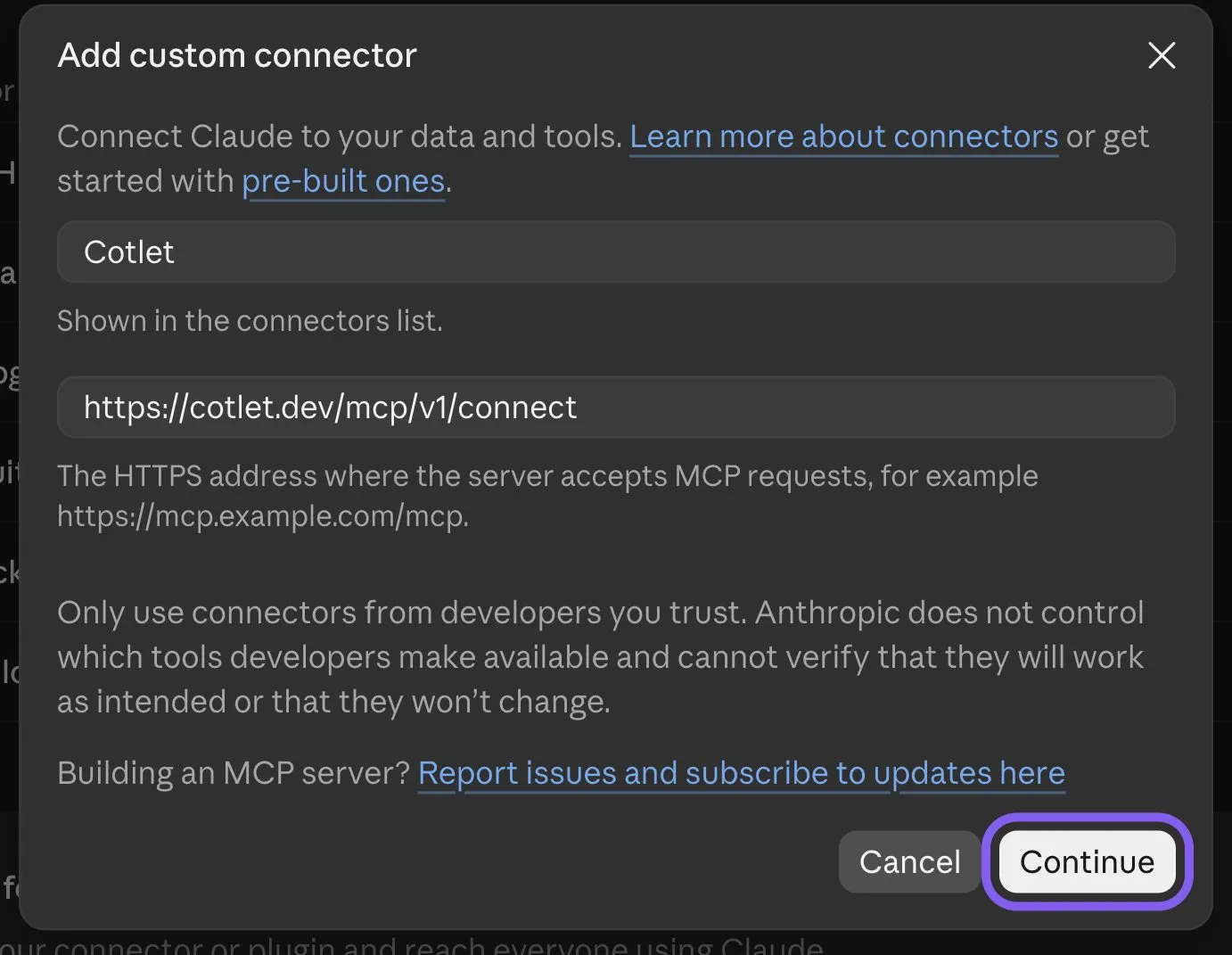
Claude, Add custom connector form, November 2026.
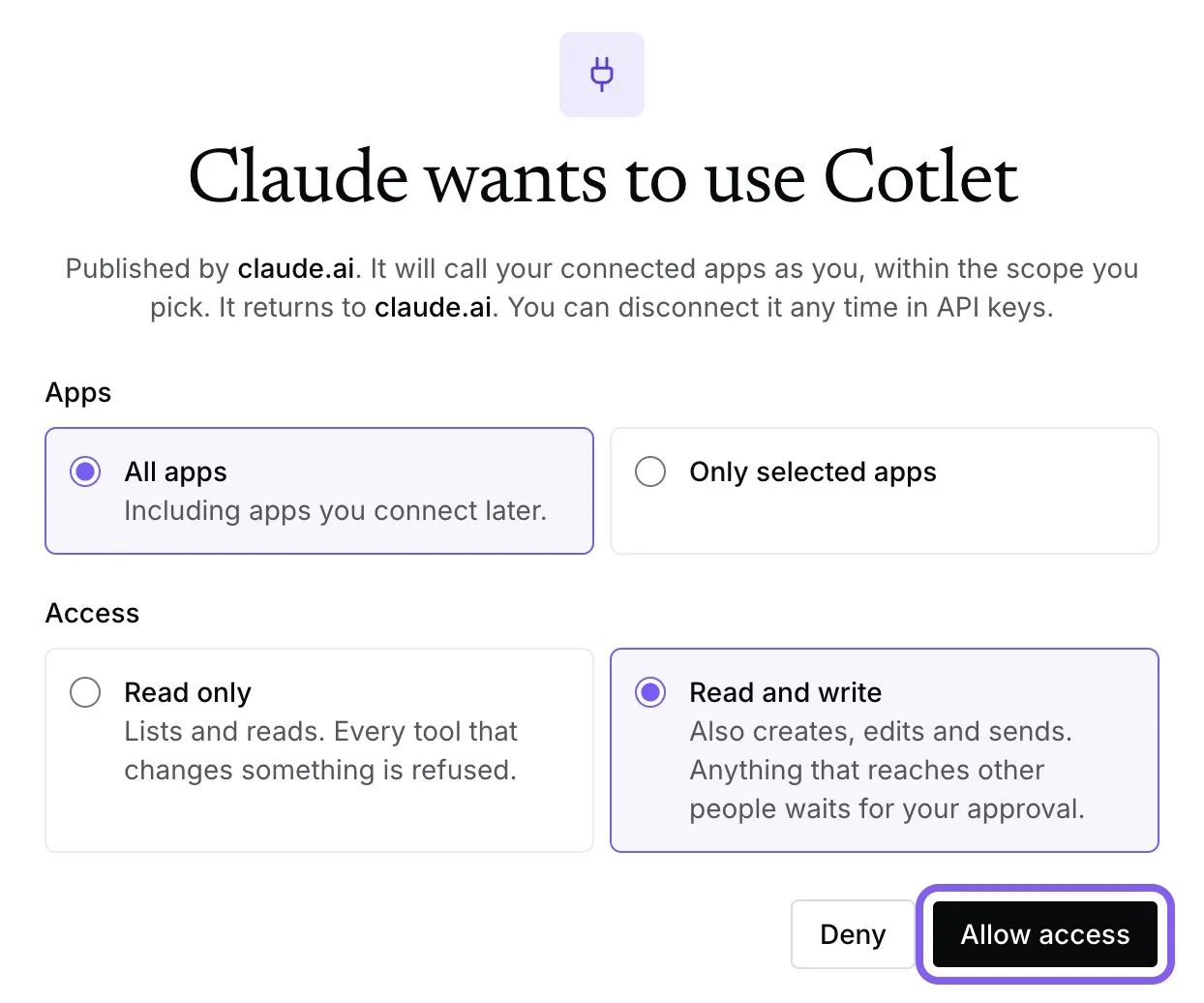
Cotlet consent page after you add the connector in Claude, November 2026.
Claude’s free plan allows one custom connector. On a Team or Enterprise plan, an owner adds Cotlet in Organization settings, Connectors, and you click Connect next to it.
How to connect TurboTenant to Claude Code
Add Cotlet without a key, then sign in once in the browser:
claude mcp add --transport http cotlet https://cotlet.dev/mcp/v1/connectRun /mcp in Claude Code, pick cotlet and sign in to Cotlet. Prefer an API key, for example on a server? Create one in the Cotlet console and use:
claude mcp add --transport http cotlet https://cotlet.dev/mcp/v1 \
  --header "Authorization: Bearer $COTLET_API_KEY"
How to connect TurboTenant to Codex
Create an API key in the Cotlet console, put it in the COTLET_API_KEY environment variable and add this to ~/.codex/config.toml:
[mcp_servers.cotlet]
url = "https://cotlet.dev/mcp/v1"
bearer_token_env_var = "COTLET_API_KEY"
How to connect TurboTenant to Cursor
Create an API key in the Cotlet console, put it in the COTLET_API_KEY environment variable and add this to ~/.cursor/mcp.json:
{
  "mcpServers": {
    "cotlet": {
      "url": "https://cotlet.dev/mcp/v1",
      "headers": { "Authorization": "Bearer ${env:COTLET_API_KEY}" }
    }
  }
}
How to connect TurboTenant to Grok
Grok takes custom MCP servers on grok.com, per xAI’s connectors documentation (checked 8 November 2026).
- Open grok.com/connectors and click New Connector.
- Pick Custom and paste the server URL
https://cotlet.dev/mcp/v1/connect. - Sign in to Cotlet when Grok asks, then click Allow access.
- Ask Grok: “Are you signed in to Cotlet through MCP?”
On Grok Business, an admin adds the connector first in the xAI console, under Grok Business, Connectors. The Grok chat inside X has no custom connector menu.
How to connect TurboTenant to Hermes Agent
Add Cotlet to ~/.hermes/config.yaml in the format of the Hermes MCP config reference:
mcp_servers:
  cotlet:
    url: "https://cotlet.dev/mcp/v1"
    headers:
      Authorization: "Bearer ${COTLET_API_KEY}"
    trust: untrusted
Put COTLET_API_KEY in ~/.hermes/.env and check it with hermes mcp test cotlet. With trust: untrusted, Hermes runs reads at once and asks before every write. More on Hermes in our post on the Hermes Agent browser.
How to connect TurboTenant to n8n
Use the MCP Client node, or the MCP Client Tool inside an AI Agent node:
- Server Transport: HTTP Streamable
- MCP Endpoint URL:
https://cotlet.dev/mcp/v1 - Authentication: Bearer Auth, with your Cotlet API key as the token
- Tools: let the AI Agent node use Cotlet’s browser tools; it reads Cotlet’s TurboTenant guide first and works in your signed-in TurboTenant account
Use it for work that should run on its own, such as an unpaid rent list on the 3rd of each month, with reminders waiting for your OK.
Any other MCP client
Point the client at https://cotlet.dev/mcp/v1 over Streamable HTTP, with the header Authorization: Bearer <your Cotlet API key>. A client that supports OAuth sign-in can use https://cotlet.dev/mcp/v1/connect instead and needs no key. The full reference is in the MCP docs.
All three are things landlords say they do by phone or spreadsheet today.
See who has not paid by the 3rd
List every TurboTenant lease with rent still unpaid this month, with the amount and any late fee. Draft a polite reminder to each tenant, and ask me before you send.
Rent day comes, and you scroll the Payments screen to see who is missing. The AI reads the charges, leaves out tenants on a payment plan if you say so, and writes one short reminder each. You approve, and the messages go out from TurboTenant. Nothing touches the money itself.
Sort repair requests by urgency
Read the open maintenance requests in TurboTenant. Put them in order of urgency by property, and draft a reply to each tenant saying what happens next. Send nothing yet.
A leaking sink and a squeaky door arrive in the same list. The AI reads each request and its photos, ranks them and drafts a reply that sets the tenant’s expectations. You choose which to send and whether to change a status. A status change waits for your OK because the tenant sees it.
Turn the rent roll into tax totals
Export last year’s rent roll and tax packet from TurboTenant and give me income per property in a table, with totals.
TurboTenant gives you the files, but adding them up per property is still your evening. The AI runs the exports from Insights, Reports and builds the table in the chat or in your Google Sheet. Your accountant gets clean numbers per door.
What it costs a landlord
Keep your TurboTenant plan. Cotlet runs on prepaid credits instead of a subscription: a $29 pack holds 5,000 and lasts a year. A typical finished call takes 10, an error takes none, and while TurboTenant is turned on for agents the Cloud Browser draws 50 a day. Your first seven days cost nothing and need no card (pricing).
FAQ
Is Cotlet the TurboTenant listing search in ChatGPT?
No. TurboTenant’s MCP server for ChatGPT and Claude helps renters search rental listings. Cotlet works in your own landlord account: rent, repairs, leads and leases.
Can AI collect rent and chase late payments in TurboTenant?
Your AI reads charges and payments in your signed-in TurboTenant account, lists who has not paid and the late fees, and drafts reminders. It sends them only after your OK and never moves money.
Does TurboTenant integrate with QuickBooks?
TurboTenant has no public API and no Zapier app, so there is no direct link from its side as of 26 November 2026. Your AI exports the rent roll and payments and puts them in a sheet you can import, or an n8n flow carries them on.
How do I export my rent roll from TurboTenant?
In TurboTenant, open Insights, then Reports, and pick Rent roll. With Cotlet, ask the AI to do it and it returns the table directly.
Can TurboTenant automate late fees and reminders?
Late fees show on the tenant’s charges in TurboTenant. The AI adds the part people still do by hand: a personal reminder to the tenants who missed the date.
Can AI answer my TurboTenant leads and schedule showings?
Yes. It reads new leads with their pre-screener answers, sorts them, and drafts a reply with showing times. Replies go out only after you approve them.
Is Cotlet part of TurboTenant?
No. Cotlet is independent and not affiliated with TurboTenant. The AI uses your own login in your own Cloud Browser.
Let the AI do the 3rd of the month
A few doors, a day job and the same chores every month. Hand the rent check and the repair queue to an assistant. Open a Cotlet account, log in to TurboTenant from the Cloud Browser and link the AI you already use. Weighing Innago instead? It sits in the catalog too.