Wire by Anakin alternatives for signed-in agent work (2026)
The Wire by Anakin alternatives worth a look and who each fits, with a fair Wire vs Cotlet table: accounts, CAPTCHA terms, pricing and catalog.
Cotlet team 10 min read
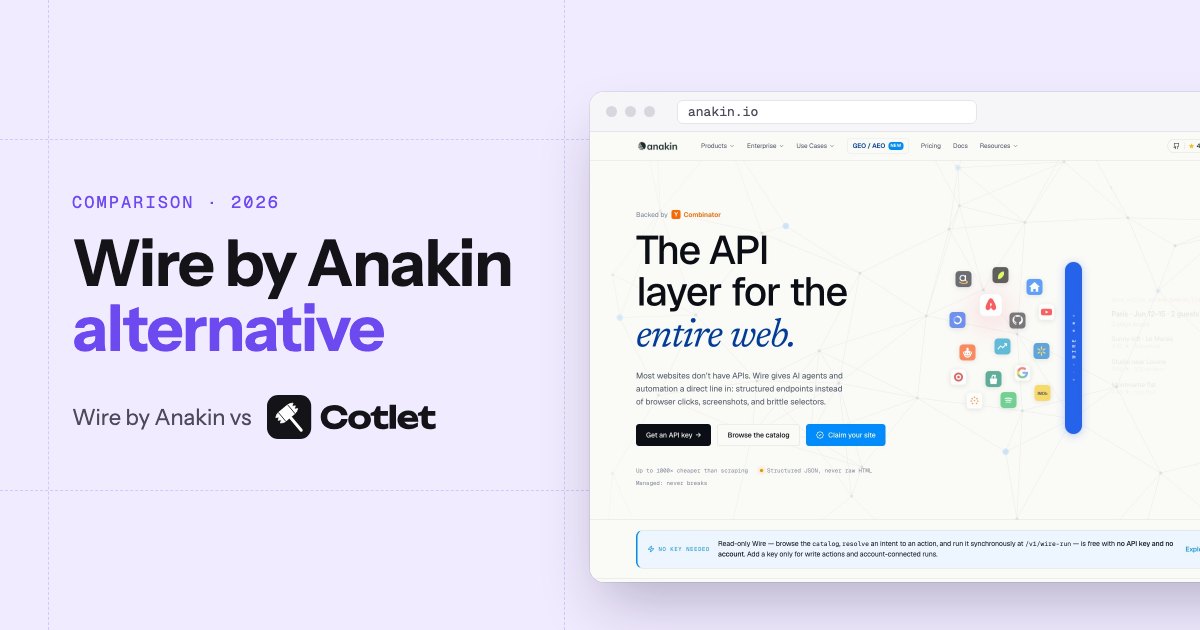
The best Wire by Anakin alternative depends on the job. If your agent mostly reads public data from many sites, Wire is hard to beat on catalog size and price, and Firecrawl or Apify are the usual comparisons. If your agent needs to do work inside your own accounts in apps with no API (post, book, reply, export), look at Cotlet, which puts every account you connect behind one MCP server. Supergood, Zatanna and Parse are the other names in this space.
Below: Wire vs Cotlet head to head, the other options, and a rule for picking one. Every fact about Wire comes from its own site, docs and terms, read on October 14, 2026. One note on the name: Wire is made by Anakin Inc at anakin.io, a different company from anakin.ai, the no-code AI app builder.
What does Wire by Anakin do?
Wire is a catalog of pre-built API actions for websites that have no API of their own. You pick an action, send parameters, and get typed JSON back. Anakin Inc is a Y Combinator company (S21, per its homepage) that also sells scraping, crawling, search and browser products under the same key.
What it offers, as of October 2026:
- A big catalog. The Wire page lists 971 sites and 5,272 actions, weighted toward shopping, finance, research and government data. Read-only actions run with no key and no account.
- REST and MCP. Every action is a REST call (
POST /v1/wire/task, then poll the job). Anakin’s MCP server, a remote connector atmcp.anakin.ioor the@anakin-io/mcpnpm package, exposes Wire next to its other tools. The July 21, 2026 changelog says Wire is split into read and write tools “so your client asks before anything state-changing runs”, and payments are refused by policy. - Identities for logged-in sites. You create an “identity” per account. The login endpoint takes a username and password, or reads them from your own 1Password or Azure Key Vault. Its docs say the password is discarded after sign-in and only the cookies are stored, encrypted. Sites that need a browser sign-in use an interactive connect flow.
- Request a site. “Don’t see a site? Submit a request; most ship within days,” says the Wire page, and a build-request endpoint generates and auto-tests a new action from your description.
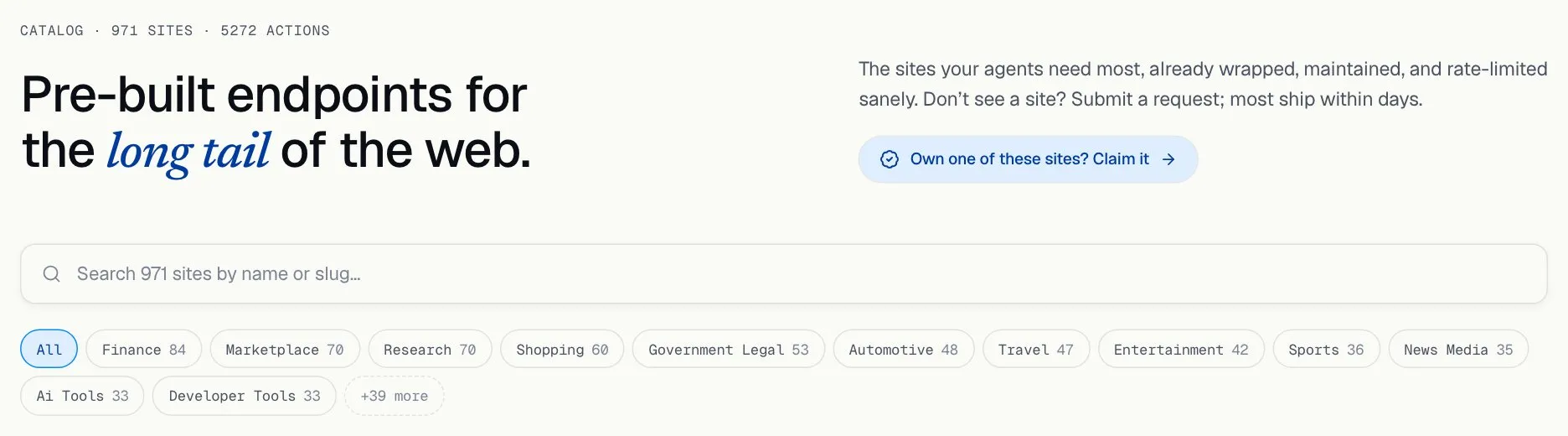
Wire by Anakin product page, catalog section, October 14, 2026 (source).
- Credits. Pricing: Starter is free with 300 credits a month, Pro is $19 for 5,000, Scale is $100 for 100,000, and annual billing saves 33%. The pricing page lists a Wire action at 2 credits per call; the catalog itself shows a cost per action (1 to 5 credits in the actions we checked). Only successful requests use credits.
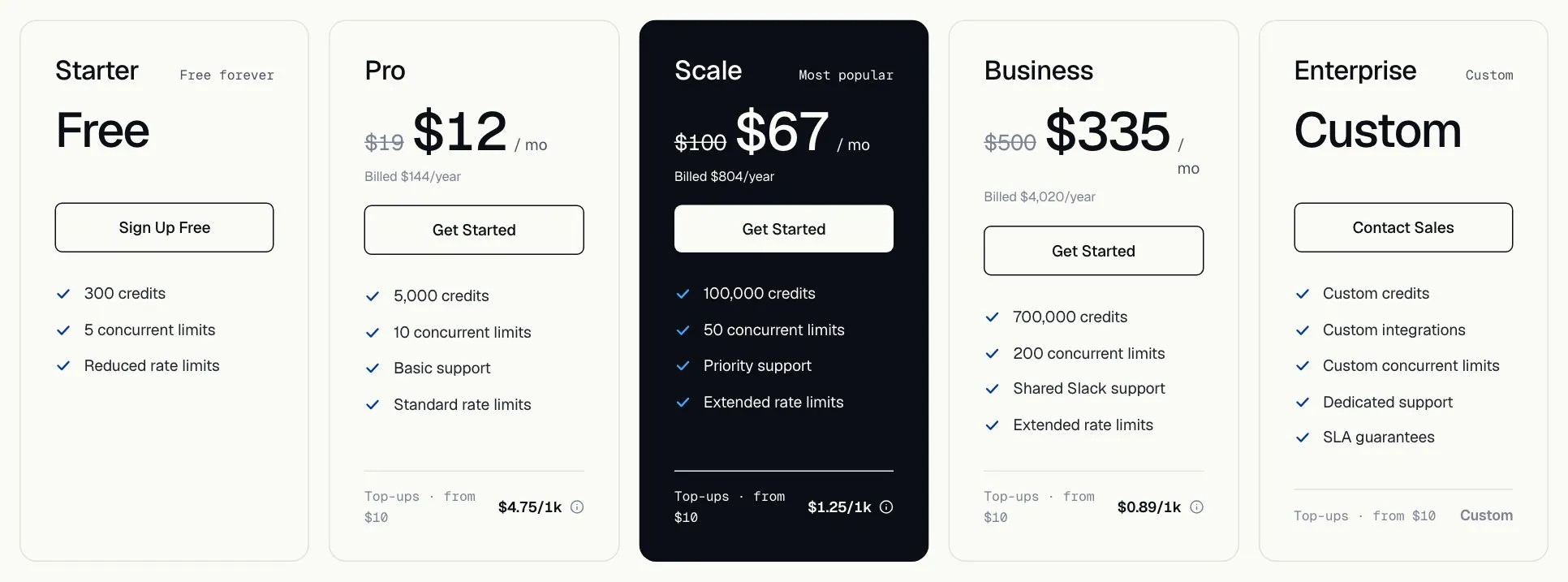
Anakin pricing page, plan cards with the default annual toggle (Pro $19 and Scale $100 a month when billed monthly), October 14, 2026 (source).
That is a strong product, and for many readers the right one.
Why look for a Wire by Anakin alternative?
The reasons we can back with public facts:
- Your apps are not in the catalog, or only their public pages are. Wire’s public catalog endpoint marks 41 of its 971 sites as needing a login. The rest are mostly public data; Substack, for example, has five public read actions (see the worked example below). Skool, Booksy and Vagaro were not in the catalog when we checked.
- You want write actions in your own account. Writes exist (Meetup RSVP, Luma event registration, following a Strava athlete), but they are a small share of the catalog.
- MFA on your account. The login API returns
MFA_REQUIREDwhen a site asks for a second factor, and the error table lists MFA sign-in as unsupported.
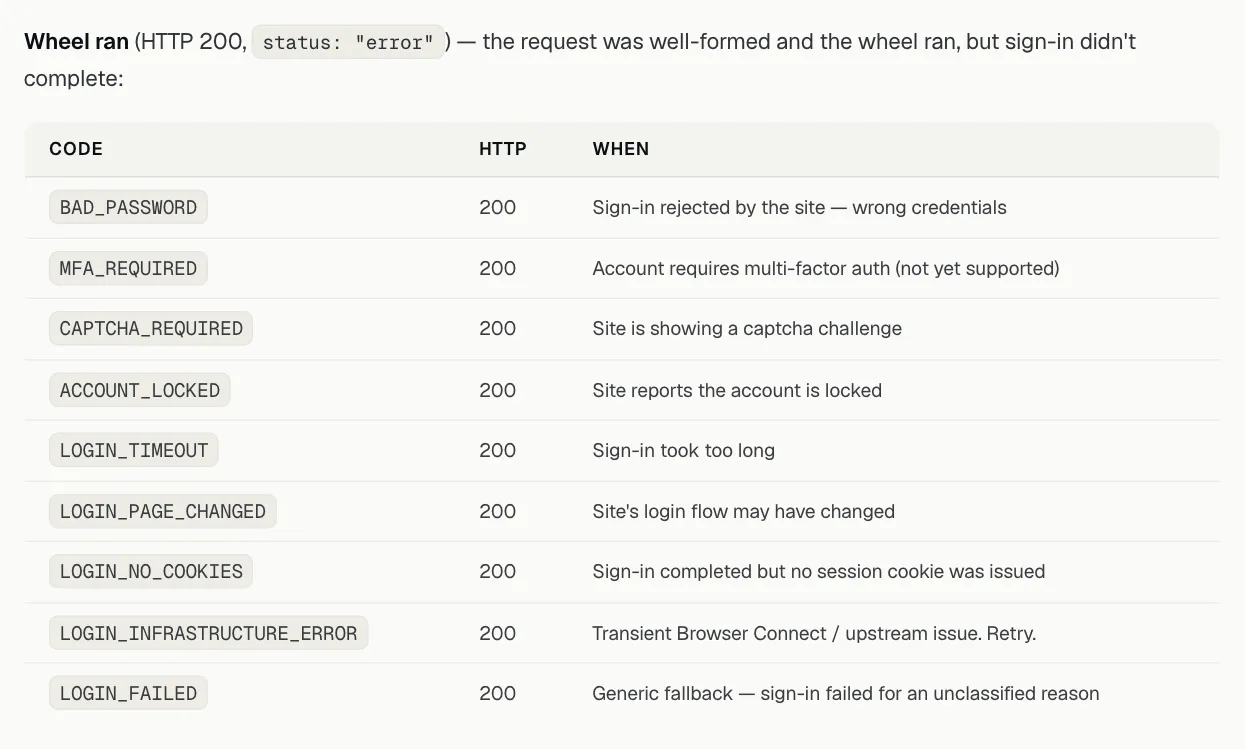
Wire API reference, Create Identity / Login, sign-in error codes, last updated August 3, 2026 (source).
- Plan credits expire monthly. On Wire, “unused plan credits don’t roll over” (top-ups and signup credits never expire), and its terms §8.3 make unused credits non-refundable.
If none of these apply to you, stay with Wire.
Wire by Anakin vs Cotlet: the comparison
| Wire by Anakin | Cotlet | |
|---|---|---|
| Built for | Developers and data teams pulling structured data from many sites | Developers and agent users whose agent works in their own accounts |
| How you get access | Self-serve signup, free tier | Self-serve sign-up with a 7-day trial; apps are added in the console |
| MCP | Yes: Anakin MCP server with Wire read and write tools, beside scraping and search | Yes: one MCP server; each connected app adds its own tools |
| REST | Yes, async jobs | Yes, your own saved endpoints, one key for both |
| Connecting an account | Password sent to the login API, a vault locator (1Password, Azure Key Vault) or an interactive connect flow | You sign in to the app yourself, once, in your own Cloud Browser, then enable it for agents |
| Passwords stored | No, per the docs: discarded after sign-in, cookies kept encrypted | No: password saving is off, the browser profile is AES-256-GCM encrypted |
| CAPTCHA and MFA | Login returns CAPTCHA_REQUIRED; MFA sign-in listed as unsupported; terms authorize access attempts when CAPTCHAs or bot detection are present |
You sign in and pass MFA yourself; Cotlet never bypasses MFA; a call returns a link when a check needs you |
| Pricing | Free 300 credits/month; Pro $19 for 5,000; Scale $100 for 100,000 | One-time packs: $29 for 5,000 credits up to $249 for 60,000; a call uses 10 credits |
| Unused credits | Plan credits do not roll over; top-ups never expire | Credit packs stay valid for 12 months and stack |
| Failed calls | Free | Free, and credits for failed calls come back |
| Catalog | 971 sites, 5,272 actions, mostly public data | Apps people request, chosen by demand: bookings, courses, communities, real estate, field services |
| Who maintains integrations | Anakin | You and your AI; Cotlet pauses an endpoint after 3 failures in a row, free |
Prices as of October 2026 (Wire, Cotlet). The two credits are not the same unit, so compare the cost of the tasks you run, not the credit counts.
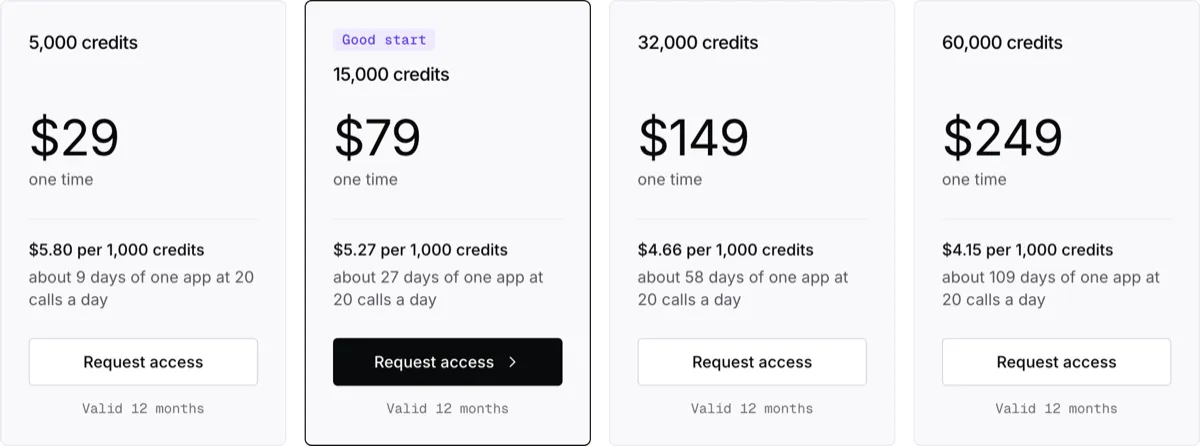
Cotlet pricing page, credit packs, 16 October 2026 (source). Wire’s monthly plan credits, by contrast, do not roll over.
On catalog size and price, Wire is ahead today, and we would rather you hear it here.
The CAPTCHA clause, and why it matters
Wire’s login stops with CAPTCHA_REQUIRED when a site shows a challenge, so we are not saying Wire solves CAPTCHAs. Its terms say something broader about every call you make. Section 6.3:
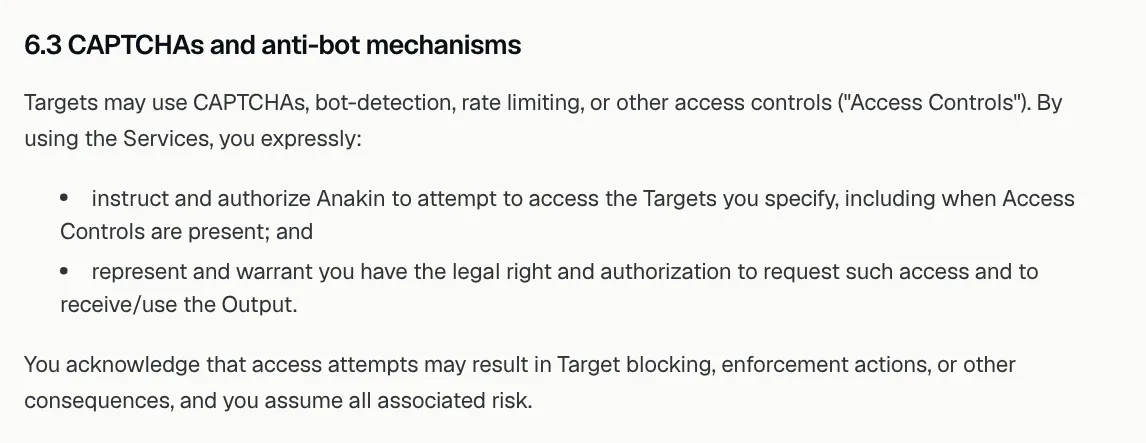
Anakin Terms of Service, §6.3 “CAPTCHAs and anti-bot mechanisms”, last updated July 23, 2026 (source).
In plain words: by using the service you “instruct and authorize Anakin to attempt to access the Targets you specify, including when Access Controls are present”, and you “assume all associated risk.”
Why it matters: US courts have treated a CAPTCHA as a technological protection measure under the DMCA, so getting past one is no longer just a contract question. We cover the cases in can AI solve CAPTCHA. This is not legal advice.
Who carries the risk? Both put it on you
Be clear-eyed here: neither service takes the legal risk off your plate.
| Term | Wire by Anakin (terms) | Cotlet (terms) |
|---|---|---|
| Compliance with the site’s terms | You are “solely responsible” (§6.1) | You are responsible; “we do not give legal advice” |
| Authority over the account | You warrant you are “authorized to provide” the login (§6.2) | You confirm you own the account or are authorized by its owner |
| Bans and blocks | Anakin is not responsible for “blocks, bans, legal notices, enforcement, or countermeasures” (§13) | We are not responsible for measures an app takes against your account |
| Indemnity | You indemnify Anakin; “Anakin does not indemnify you” (§17) | Business customers indemnify Cotlet for use in breach of the terms |
| Liability cap | Greater of $100 or one month of fees (§16) | Greater of $100 or 12 months of fees, for business customers |
What differs is what the service does for you, such as whether it stops when the site owner objects. Cotlet pauses an integration for everyone within 24 hours of a cease-and-desist and refunds the affected credits.
A worked example: Substack
Say you run a newsletter and want your agent to draft Thursday’s issue from your notes, schedule it, and pull last week’s open stats.
- On Wire: the Substack actions read public posts and search. They do not write a draft, schedule it or read stats from your dashboard. You would request a build and wait.
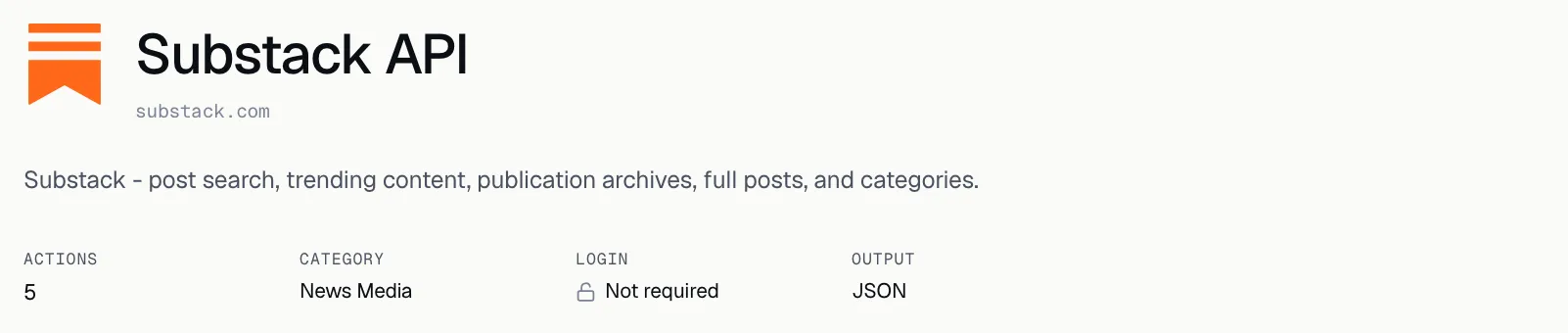
Wire catalog, Substack page, October 14, 2026 (source).
- On Cotlet: the Substack integration lists Create post, Schedule post, Publish Note, List subscribers and Get post stats. You sign in to Substack once; your agent sees those tools next to every other app you connected. A post waits for your OK before it goes out.
- The open-source route: python-substack and several MCP servers on GitHub do parts of this with a copied cookie. Our post on open source MCP servers for apps with no API has a checklist for those.
For “track prices on 40 retail sites”, the answer flips: that is Wire’s home ground.
Other Wire by Anakin alternatives
- The official API. If one covers your task, use it. No unofficial integration beats a contract and a changelog.
- Composio, Pipedream or Zapier. For apps that do have official APIs. Composio connects agents to “1,500+ apps” over OAuth and API keys.
- Firecrawl or Apify. For public pages at scale with no login. These are the tools Anakin compares itself to.
- Browser agents such as Browser Use. MIT licensed, run locally or in their cloud; flexible, but slower and costlier per task. See browser automation vs API.
- Supergood, Zatanna and Parse. Closer to Wire in shape, each with its own access model. We cover each one: Supergood, Zatanna, Parse.
When to stay with Wire by Anakin
- Your sites are in its catalog and the actions you need are there.
- Your work is mostly reading public data: prices, listings, reviews, filings.
- You want a free tier forever and the lowest price per call.
- Your logins live in 1Password or Azure Key Vault and you want them read from there.
Which one should you pick? A decision rule
- Official API covers the task? Use it.
- Public data, many sites? Wire, or Firecrawl and Apify.
- Your own accounts, writes, in apps with no API, and you want one MCP server for all of them? Cotlet.
- One internal system, a budget, and you want someone to build it for you? Supergood or Zatanna.
- One-off or read-only, and you like maintaining code? An open-source repo you have read.
Before connecting any service to an account, check who types your password, what happens at a CAPTCHA, and what the terms say about bans.
Where Cotlet fits
Cotlet is for the case in rule 3. How Cotlet is designed to work: you sign in to each app yourself in your own Cloud Browser and enable it for agents, and your agent gets one MCP server (plus REST) with every connected app as tools. Only successful calls use credits, bought in packs valid 12 months. We never bypass MFA or keep your payloads, and the catalog grows from the apps people request.
Every app is open to every account. Browse the integrations, then sign up and add your apps in the console, and nothing is charged until you buy a pack.