Zatanna alternatives: 5 options for apps with no API (2026)
Zatanna AI turns portal workflows into custom APIs on a sales call. The alternatives, a side-by-side table with Cotlet, and a rule for picking one.
Cotlet team 9 min read
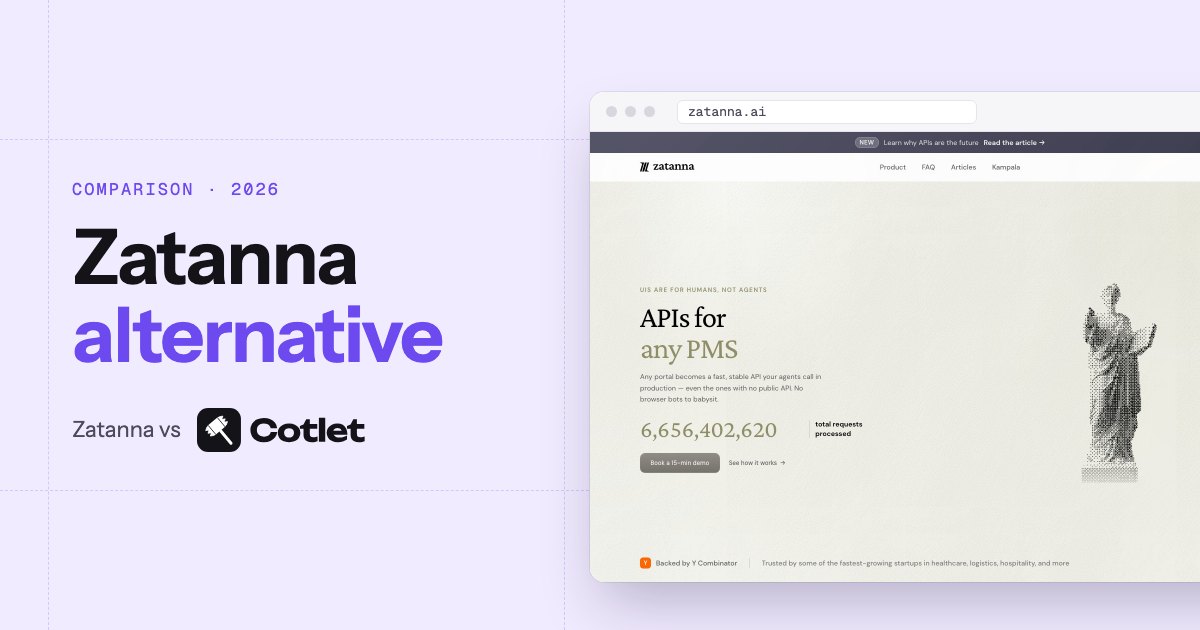
The best Zatanna alternative depends on what you need. If you want one team to capture a custom portal workflow and host it as an API for your company, Zatanna (zatanna.ai, the YC startup, not the DC Comics magician) is a strong pick, and Wire by Anakin or Supergood play in the same field. If you are a developer or agent power user who wants self-serve access, public prices and one MCP server with all your accounts, Cotlet fits better; if the app has an official API, use that instead.
This post covers what Zatanna and its Kampala app actually do, why people look elsewhere, a side-by-side table, the other options, and when you should stay with Zatanna. Every fact about Zatanna comes from its own pages, read in October 2026.
What does Zatanna do?
Zatanna (Winter 2026 batch, incorporated as NoPoll Inc.) describes itself on its YC page as a company that “creates APIs for software that doesn’t have any” by reverse engineering the back ends of web and on-prem software. It has two parts.
The hosted service. On zatanna.ai (as of October 2026) the process has three steps: “Walk through the workflow once” while Zatanna captures every network request, then it reconstructs the request flow, then your agents “call one stable endpoint”. The FAQ says “Most integrations are live within days”, that Zatanna handles “stateful auth, MFA, cookie management, and session refresh automatically”, and that broken tools are detected and repaired. The site targets ERPs, freight and insurance portals, health records and other back-office software. Access starts with “Book a 15-min demo” or a 30-minute workflow review.

Zatanna homepage, “Reliability layer” section, October 2026 (source).
That list is the honest summary of the product: it is built to keep a captured flow working, including against anti-bot systems.
Kampala. Kampala is a Mac app (Windows is listed as next) that works as a man-in-the-middle proxy: it shows “every HTTP/S request from any app or browser”, maps “tokens, cookies, sessions, and multi-step sequences”, replays flows and keeps “the HTTP and TLS fingerprint so intercepted traffic behaves like the original”. In the Launch HN post (April 16, 2026), co-founder Alex Blackwell explained that you can build scripts through Kampala’s own agent or its MCP with your coding agent, then “export, run, or even have us host it for you”.
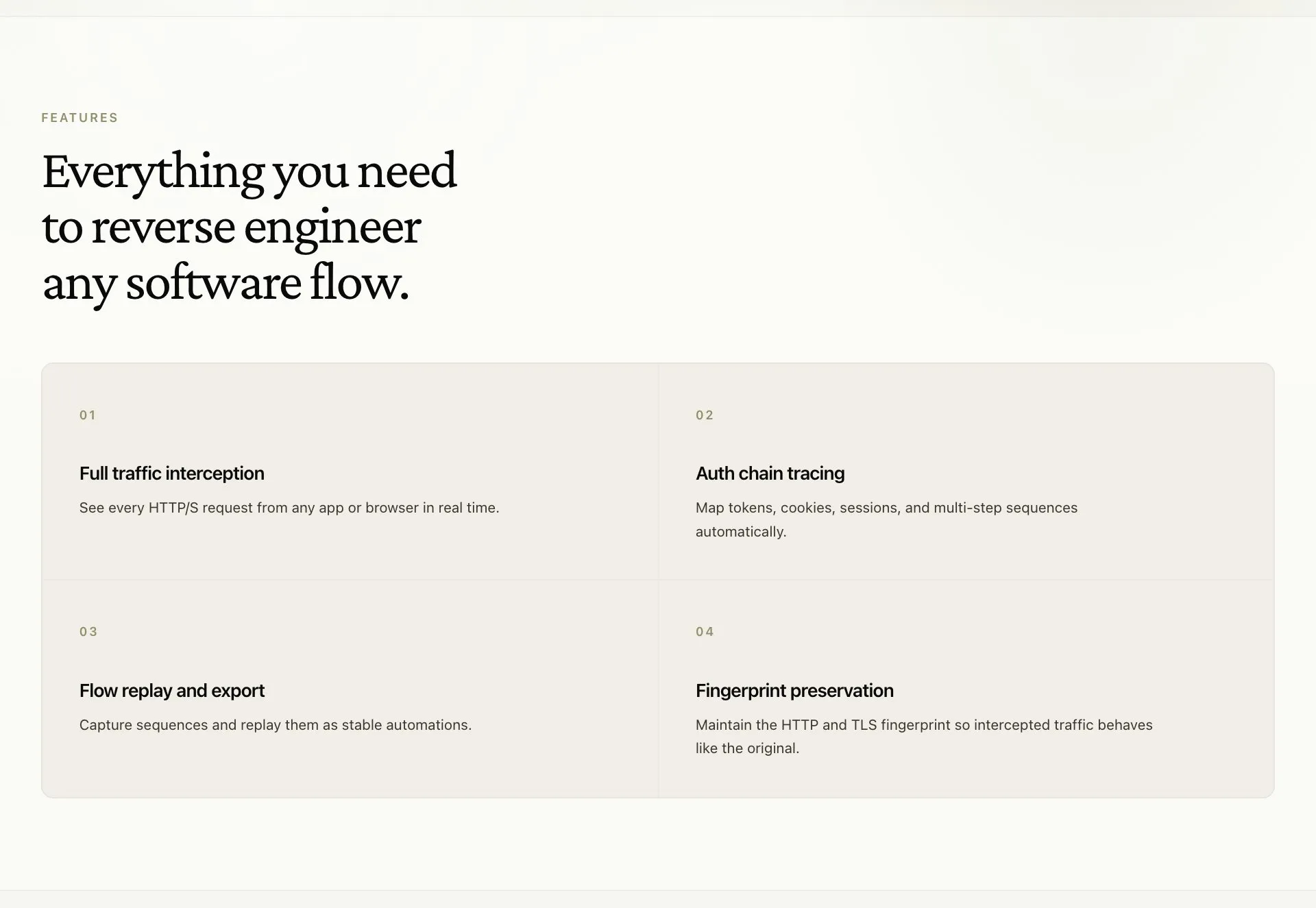
Kampala page on zatanna.ai, “Features” section, October 2026 (source).
Why do people look for a Zatanna alternative?
Only reasons you can check on public pages:
- No public pricing. There is no pricing page on zatanna.ai as of October 2026, and the terms (updated July 3, 2026) say fees are whatever is “described in your order or agreement with us”. You find out the price on a call.
- APIs per workflow, not a catalog. You bring a workflow and get an endpoint for it. There is no public list of apps that are ready to use.
- No hosted MCP server for your accounts. Kampala has an MCP for building scripts, but the hosted product is described as “one stable endpoint” per workflow. If you want Claude Code or Cursor to see all your apps as tools behind one URL, you assemble that yourself.
- The stance on bot detection and terms of service. Some teams are fine with it, some are not. More on that below.
- Sales-led access. Every call to action on the site books a meeting. That suits a company with a budget line, less so a developer who wants to try one workflow tonight.

Zatanna homepage hero, October 2026; the last word of the headline rotates through types of software (source).
Captured browser cookies vs signing in on the provider’s side
This is the difference that matters most, and it is easy to blur.
Capturing your session. A MITM proxy only reads HTTPS traffic because you install its root certificate on your machine. The mitmproxy docs say it plainly: decryption works “as long as the client trusts mitmproxy’s built-in certificate authority”, which “usually means that the mitmproxy CA certificate has to be installed on the client device”. Once that is done, the tool sees every login, token and cookie your browser receives, including the cookies anti-bot systems set after they decide you are human. On Hacker News, Blackwell described the approach as “piggy-backing on the session/anti-bot tokens from your browser”, which he said “usually works”.
Signing in on the provider’s side. The other model never touches your machine’s traffic. You sign in to the app yourself in a browser the provider runs for you (at Cotlet, your own Cloud Browser), pass any MFA prompt yourself, and calls run on that browser’s cookies and IP. When the app signs you out, you are asked to sign in again. Nothing on your laptop is intercepted, and no anti-bot cookie earned by your own browsing is reused somewhere else.
Neither model makes you immune to an app’s terms. Zatanna’s terms put that on you: you warrant you have the rights to connect each system and are “responsible for ensuring your use of the services complies with the terms” of those systems. Most providers in this space, Cotlet included, put the same responsibility on the customer. What differs is what the tool does when an app pushes back.
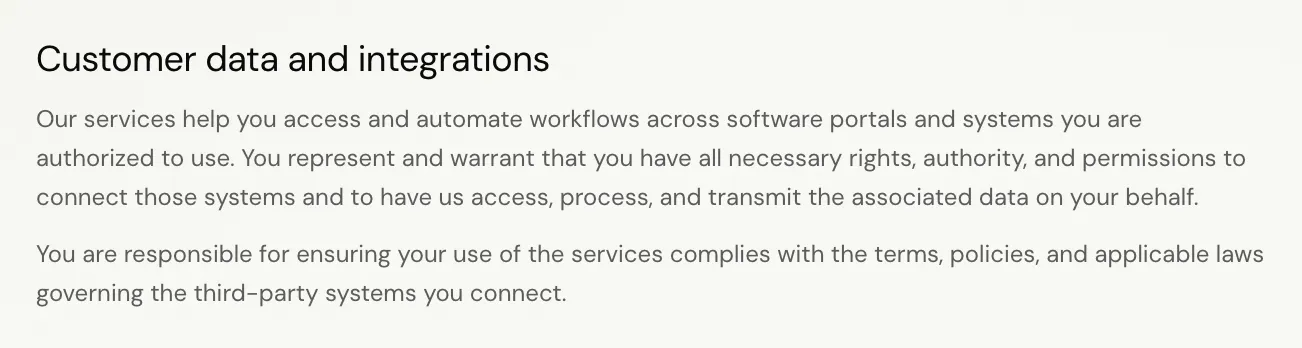
Zatanna Terms of Service, “Customer data and integrations”, last updated July 3, 2026, read October 2026 (source).
On Launch HN, Blackwell argued that many terms-of-service clauses are “so broad and vague that they’re essentially unenforceable”, and replied to a critic: “I wouldn’t consider what we do evasion really. We are using real tokens that you have received from your browser”. He also said hosted workflows are rate-limited “to prevent mass scraping”. That is a coherent position, stated openly. If you disagree with it, that is a reason to pick a different tool, not a scandal. For the wider question of CAPTCHAs and MFA, see can AI solve CAPTCHA. This is not legal advice.
Zatanna vs Cotlet: side by side
Zatanna facts are from its own pages as of October 2026. Cotlet facts are from its security, pricing and help pages.
| Zatanna | Cotlet | |
|---|---|---|
| Who it is for | Companies with a specific portal workflow, often back-office (ERP, insurance, health records) | Developers and agent power users (Claude Code, Codex, Cursor, ChatGPT, n8n) |
| How you get access | Book a demo or workflow review | Sign up online and add your apps in the console |
| MCP | Kampala ships an MCP for building scripts; hosted product is an endpoint per workflow | One MCP server with every app you connect |
| REST | Yes, a hosted API per workflow | Yes, your own saved endpoints, same key |
| How accounts are connected | Workflow recorded once; Kampala captures tokens and cookies from your traffic | You sign in to each app yourself, once, in your own Cotlet Cloud Browser, then enable it for agents |
| Passwords stored | Not stated on the site | No. Password saving is off; the browser profile is encrypted with AES-256-GCM |
| CAPTCHA and MFA | “Anti-bot & TLS fingerprint hardening”; MFA handled “automatically” | You sign in and pass MFA yourself; never bypasses MFA; a call returns a link when a check needs you |
| Pricing | Not published; set per order | Published: credit packs from $29, one-time, no subscription; 7-day trial |
| Catalog | None public; you bring the workflow | Public catalog of apps with no or a narrow API |
| Who maintains integrations | Zatanna, with change detection and auto-repair | You and your AI; Cotlet pauses an endpoint after 3 failures in a row and refunds failed calls |
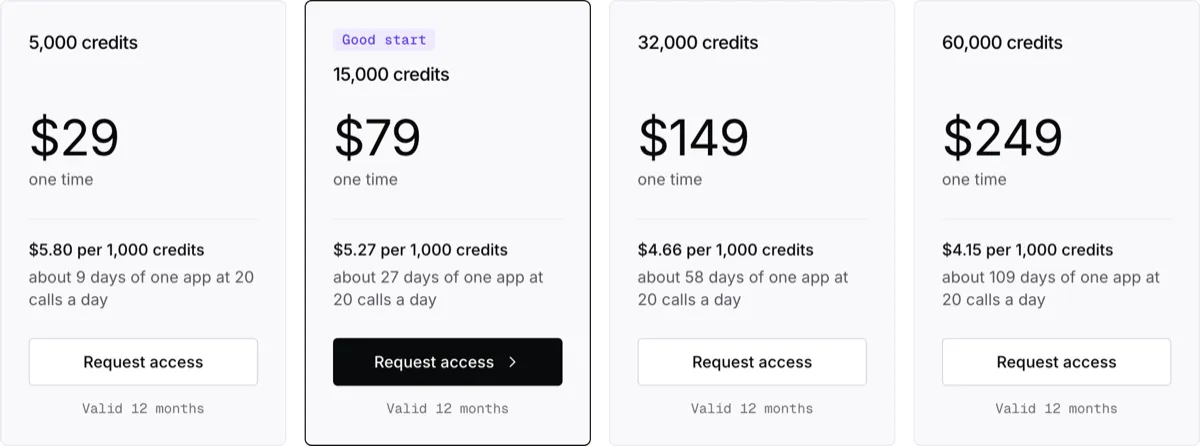
Cotlet pricing page, credit packs, 16 October 2026 (source).
The two products overlap less than the table suggests. Zatanna builds a custom API around your workflow. Cotlet ships a fixed set of actions per app (for Skool: list members, approve membership requests, create posts, send DMs) and lets any number of people connect their own account to them.
Other Zatanna alternatives
- The official API. Check first. If the vendor has one that covers your job, use it, through your own code or through Composio, Pipedream or Nango, which connect agents to official APIs. It is supported, documented and nobody’s terms are in question.
- Wire by Anakin, Supergood, Parse. Hosted integrations for apps without a usable API, each with a different access model and price. We compare them in their own posts: Wire by Anakin alternative, Supergood alternative and Parse alternative.
- Open source browser agents. Browser Use (MIT licence, about 118,000 GitHub stars) and Skyvern (AGPL-3.0, about 23,000 stars), as of October 2026, drive a real browser. Slower and less predictable than calling requests directly, but free and fully yours. The trade-offs are in browser automation vs API.
- Do it yourself with a proxy. Kampala’s workflow is reproducible with mitmproxy, the browser’s network tab and a coding agent. Fine for one app you know well, but you become the maintainer. Our post on GitHub scripts vs hosted integrations has a checklist.
How to choose: a five-question rule
Answer in order and stop at the first yes.
- Does the app have an official API that covers the job? Use it.
- Is this one custom, high-volume workflow your company will pay a vendor to own? Talk to Zatanna, Wire or Supergood.
- Do you need it to run on your own machine, and are you willing to fix it when it breaks? Kampala, mitmproxy or a browser agent.
- Do you want your agent to reach several apps from one MCP server, at a published price, signing in yourself? Look at Cotlet’s catalog.
- None of the above? Do it by hand a few more weeks and write down exactly which steps repeat. That list is what any of these tools will ask you for.
When to stay with Zatanna
Stay if you have a back-office workflow in a portal, ERP or on-prem system that nobody else lists, and you want a team to capture it, host it and repair it. Zatanna’s background is exactly that work: the founders built integrations for dental insurance portals and on-prem software before Kampala, by their own account. Stay too if you want a local, Proxyman-style tool for your own reverse engineering; Kampala is built for that and Cotlet is not. And stay if a sales-led contract is how your company buys software anyway.
Where Cotlet fits
Cotlet is designed for the person who asked an agent to do something in Skool, Booksy or Dubsado and was told the app has no API. It hosts the integrations, gives you one MCP server for your agent and your own saved endpoints over REST for scripts, under one key. You sign in to each app yourself, once, in your own Cloud Browser; Cotlet never saves your password, lists every background request and keeps no payloads after a call. It never bypasses MFA, does not touch LinkedIn or Instagram, and pauses an integration within 24 hours if the app owner objects. The full list is on the security page.
The limits are real: ready tools exist for only a few apps, other apps run through the browser tools at a browser’s pace, and an app that blocks automated sessions outright is one Cotlet will not fight.
Every app is open to every account. Sign up and press Activate on your app, listed in the catalog or not; nothing is charged until you buy a pack.